There’s a reason a three-star Michelin restaurant earns the trip, not just the meal. Three stars means worth a special journey. It isn’t about more food. It’s about intention—every course sequenced, every detail considered, every guest left thinking differently than when they walked in.
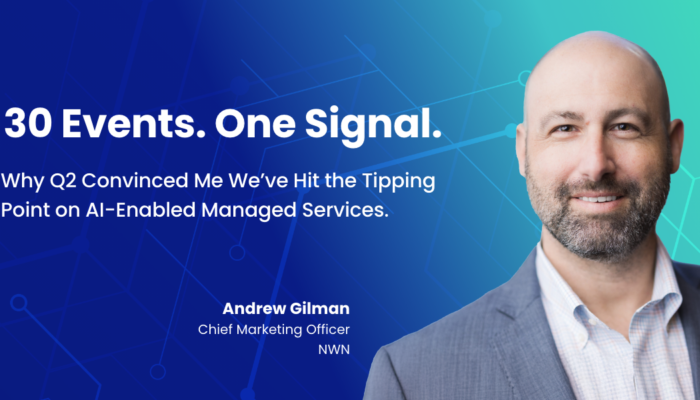
That’s the bar we hold ourselves to for NWN’s events and programs. And it’s a bar we cleared a lot in Q2: more than 30 events in a single quarter—from innovation labs and demo centers to executive roundtables and our marquee gathering of the year. We don’t run events to fill a calendar. We run them to elevate the conversation—to get a room of technology leaders past the AI hype cycle and into the work that actually moves their businesses forward.
The clearest proof of that this quarter was our 4th Annual Newport Summit. Four years in, and our CEO Jim Sullivan said it best on night one: in his words, we’ve “probably never had this much change since the introduction of cloud.” Here’s what that change looked like from inside the room.
The Risk Equation Just Got Rewritten
We opened with Tom O’Brien, President of Palo Alto Networks East and a 30-year friend of Jim’s, and he didn’t waste the stage on a product pitch. His message to the room: the math of cyber defense has fundamentally shifted.
For years, defenders had a window. A vulnerability got discovered, you had a day or two—a Patch Tuesday, a weekend—to shore up. O’Brien’s point was that the window is collapsing toward minutes. He shared that Palo Alto’s own time to detect and respond went from days three years ago to under 15 minutes today, with a target of 5—because below that line, adversaries stay ahead of you.
“When you’re getting 10,000 alerts an hour, you can’t have somebody triage that. You fight AI with AI.”
— Tom O’Brien, Palo Alto Networks
His prescription wasn’t novel, and that’s exactly why it landed. Zero trust. Identity at the forefront. Automation in the SOC. A platform approach instead of 75 disconnected tools held together by exhausted engineers.
The takeaway for the room: the playbook hasn’t changed. The clock has. The leaders who win the next six months are the ones already executing the plans they’ve been sitting on.
Legacy Isn’t a Foundation. It’s a Tax.
Josh Laufenberg from AWS followed with the line that stuck with half the room:
“Legacy is something you want to talk about in your brand, not in your IT stack.”
— Josh Laufenberg, AWS
His case was blunt and backed by numbers. Most organizations spend 60 to 80% of their IT budget just maintaining what they already have—and across the U.S., that legacy tech debt adds up to roughly $1.5 trillion a year. Every dollar spent maintaining is a dollar not spent innovating.
What’s changed is the cost of getting out from under it. Josh walked through real results: Bridgestone, the world’s largest tire company, modernized 1.2 million lines of COBOL to Java in seven months—not the seven years the traditional consultants had quoted. Avista, a gas utility, scaled to 9x its call capacity when storms hit. U.S. Foods cut proposal prep from four hours to twenty minutes, and 30-year veteran sellers adopted it inside two weeks.
He saved the best proof point for us: the disability insurance program NWN modernized for the State of California two and a half years ago. His read? With today’s AI tools, we could do that same work ten times faster and at lower cost now. The threshold for modernization has dropped through the floor.
The takeaway for the room: start the conversation by naming your boat anchor. Then start small—pick the one thing that changes your people’s day—and let the win build the case for the next.
Governance Is the Accelerator, Not the Brake
The customer voices were where Newport earned its stars. In healthcare, Penn Medicine board member and NWN director Michael Barrett sat down with Optum’s Charles Coles; later, NWN CRO Dan Tassone hosted Jeff Wade, who runs technology for Fairview Health.
Both pushed back on the idea that governance slows you down. The real story is subtler. Fairview deliberately started slow—policies, clinician engagement, the unglamorous groundwork—because in a hospital, as Wade put it, “we’re not a tech company, we’re a healthcare company,” and the mission is different. But once the foundation held, adoption moved fast. When they rolled out ambient listening so doctors could look at patients instead of screens, it caught on “like wildfire” and their provider satisfaction score climbed.
His sharpest insight was operational: you can’t route everything through the same approval gate. Clinical AI that touches patient care needs deep governance and clinician buy-in—because, as he noted, if one doctor has a bad experience, every other doctor hears about it. But a back-office HR chatbot doesn’t need nine layers of red tape. Fairview’s answer was a multi-track model: match the rigor to the risk.
Coles reinforced it from the Optum side—what he affectionately called the “Optum love,” reshaped over a decade from a single take-it-all package into modular, turnkey services. His non-negotiable: he won’t take on an engagement unless it can demonstrate at least a 30% ROI for both sides. (Notably, AWS cited the same 30% figure independently—a number that kept surfacing all week.)
The takeaway for the room: governance done right isn’t the thing standing between you and AI. It’s the thing that lets you scale AI without breaking trust.
Your Data Pipelines Are Fine. Your Definitions Aren’t.
Paul DiMarino, CIO of Shawmut Design and Construction, delivered the session that made the most technical leaders in the room nod and wince at the same time.
Construction doesn’t scream “AI readiness.” But DiMarino reframed a $500 million building as “a giant logistics problem”—thousands of scheduled activities a week, razor-thin margins where one slip costs you. His team rebuilt the industry-standard bid spreadsheet into a real application after a single spreadsheet error cost them $1 million. The math was easy after that.
“Your data pipelines are fine. Your definitions aren’t.”
— The AI-readiness insight from Newport Summit 2026
Everyone talks pipelines, validation, and data models. Almost nobody talks about definitions. Ask an AI model “what percent complete is this project?” and—without a shared corporate definition—it can’t know whether you mean days elapsed, activities finished, or revenue billed. “There’s a million different definitions,” he said, and without a contextual layer, you get confident, wrong answers.
The twist? AI turned a years-long uphill battle into a tailwind. Getting business teams to invest in clean data used to be impossible. Now everyone wants AI—and AI requires exactly that foundation. As DiMarino put it: people are “lining up” to do the data work now. His advice: take advantage of the window, because it won’t last forever.
The takeaway for the room: AI readiness isn’t a data-engineering problem. It’s a shared-language problem. Fix the definitions and the insights get honest.
The Most Honest Conversation Was About Money
We closed with our own practitioners—Alvaro Riera, Kevin Kuning, and Brent Lazarenko—because the most valuable thing we can offer a room of leaders is candor about what doesn’t work.
Lazarenko, cheerfully admitting he’s “the one propagating most of the hype” at NWN, dismantled it anyway. The myth that fully autonomous, agentic automation saves all the money? Not yet. A well-architected, human-in-the-loop solution is more cost-effective in the long run. He even coined the quarter’s best acronym:
“Forget EBITDA. Meet EBTDA: Earnings Before Tokens, Depreciation and Amortization.”
— Brent Lazarenko, NWN
Brent also cited an industry study showing 82% of AI pilots over the last two years failed or missed their outcome—and crucially, the top three causes weren’t technology. They were speed to market, getting the customer-adoption experience wrong, and cost. Kuning sharpened the economics with a number every leader should sit with: coding agents that started at a $20/month subscription can climb to $4,000 a month per engineer. The cost of success grows faster than the success.
The takeaway for the room: stop saying no. Saying no just drives AI underground. Provide the right solutions, with the right guardrails and the right economics, and you turn rogue experimentation into governed advantage.
And Then We Celebrated the People Doing the Work
Newport has always been about more than keynotes. This year we recognized two leaders with our Newport Next Awards: the Marriott team, for redefining customer-centric innovation at a global gold standard in hospitality; and the team at The Hartford, who went from standing on our very first Newport stage to spearheading practical AI from the service desk to the total employee experience. Both earned a round of applause, a clambake, and our genuine admiration.
Why This Matters Beyond One Experience
Here’s the thread running through all of it. The technology was the backdrop. The real subject—every single session—was people. Trust between a doctor and a patient. Buy-in from a 30-year veteran seller. A clinician who’ll champion a tool or quietly kill it. Front-line engineers who flip their own workflow once the AI earns it.
That’s the conversation we’re built to host. It’s why NWN has spent seven years investing in our Experience Management Platform, why we’ve grown from a mid-$200M business in 2019 to $1.3 billion in sales, and why we hold an 87 customer Net Promoter Score and an employee NPS in the 80s—numbers we hold with what Jim calls “tremendous humility.” We don’t measure ourselves by the tools we sell. We measure ourselves by the outcomes our customers and partners walk away with.
Thirty-plus events in a quarter. One unforgettable Summit. A room that left thinking differently than it arrived.
Worth the journey. That’s the only review we’re chasing.
Ready to join the conversation? Follow NWN on LinkedIn to see where we’re elevating the table next.